From Canvas to Ceramic: The Art Behind the Strøm Jug

How the paintings of a Danish modernist inspired Nicholai Wiig-Hansen to reconsider the artistic possibilities of an everyday household object.
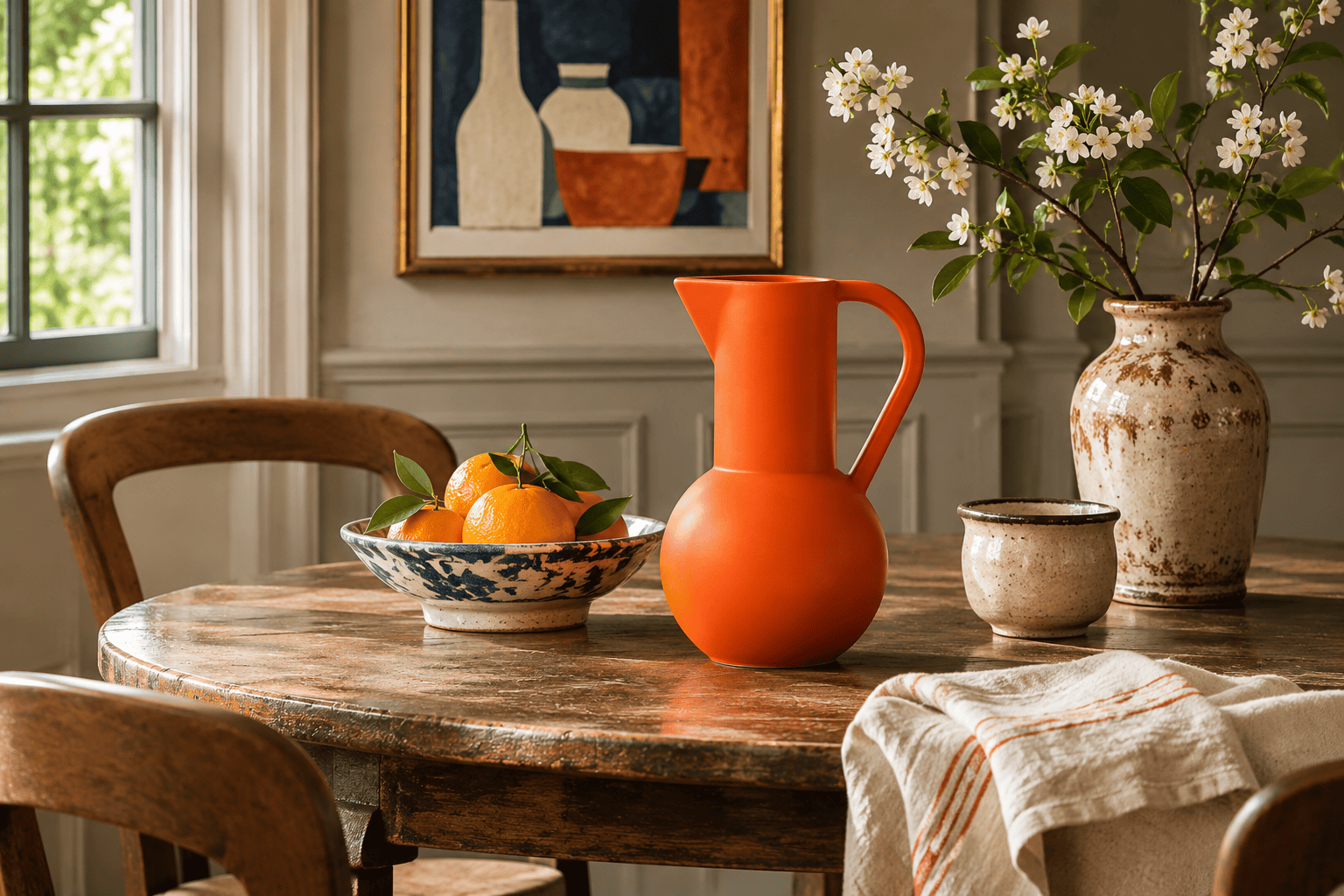
There is a rather lovely circularity to the story of Nicholai Wiig-Hansen’s Strøm Jug.
Almost a century ago, Danish painter Vilhelm Lundstrøm was looking at ordinary household objects with an extraordinary eye. Jugs, bowls and bottles became compositions of colour and geometry, their familiar shapes simplified until little remained beyond their essential character.
Decades later, Wiig-Hansen looked at those paintings and began to reverse the process, bringing their forms back into the physical world.
The result is an object that belongs as comfortably on a breakfast table as it does in a gallery.
An artist’s way of seeing.
Vilhelm Lundstrøm, born in 1893, was a central figure in Danish modernism. His still-life paintings reveal a fascination with the relationships between objects, the spaces they occupy and the colours that surround them.
A white jug beside an orange becomes something more than an arrangement of household possessions. It becomes an exercise in balance, contrast and proportion.
There is something remarkably contemporary about these paintings. Their bold compositions and confident use of colour feel just as relevant to the interiors we create today as they did to the artistic conversations of the last century.
Lundstrøm’s work invites us to look a little more carefully at the things we ordinarily overlook.
From the canvas to the everyday.
The story of Strøm connects two generations of Danish creative thinking, separated by decades but united by an appreciation of colour and form.
Vilhelm Lundstrøm is born in Denmark. He would become one of the country’s important modernist painters.
Modernist ideas and Cubist influences help shape Lundstrøm’s distinctive approach to everyday objects and still-life compositions.
Nicholai Wiig-Hansen designs the Strøm ceramics, interpreting the artistic language of Lundstrøm through three-dimensional objects.
An exhibition exploring Vilhelm Lundstrøm and the concept of good taste connects his artistic legacy with contemporary design at Brandts and Kunsten Museum of Modern Art Aalborg. The Strøm collection becomes the foundation of the newly established Danish design brand raawii.
Bringing the painting to life.
The Strøm collection emerged from a collaboration with the Danish art museum Brandts, where Lundstrøm’s work provided a starting point for Wiig-Hansen’s exploration of ceramic forms.
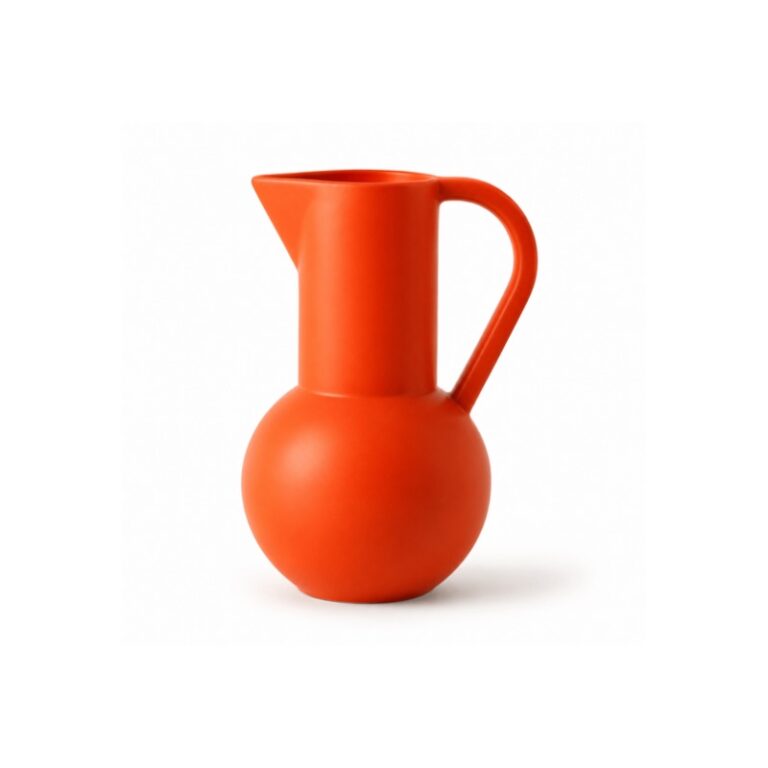
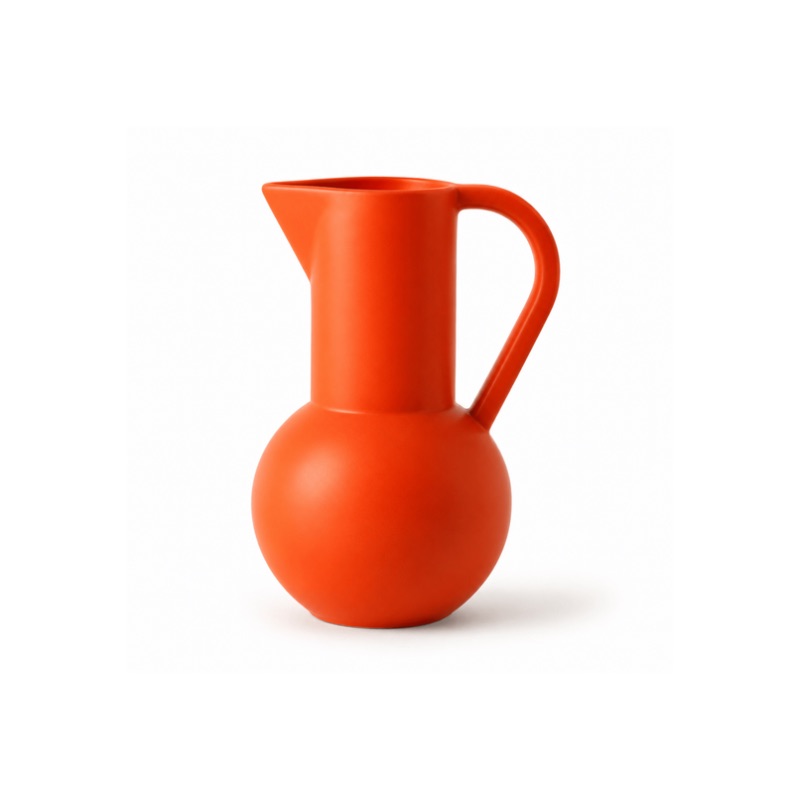
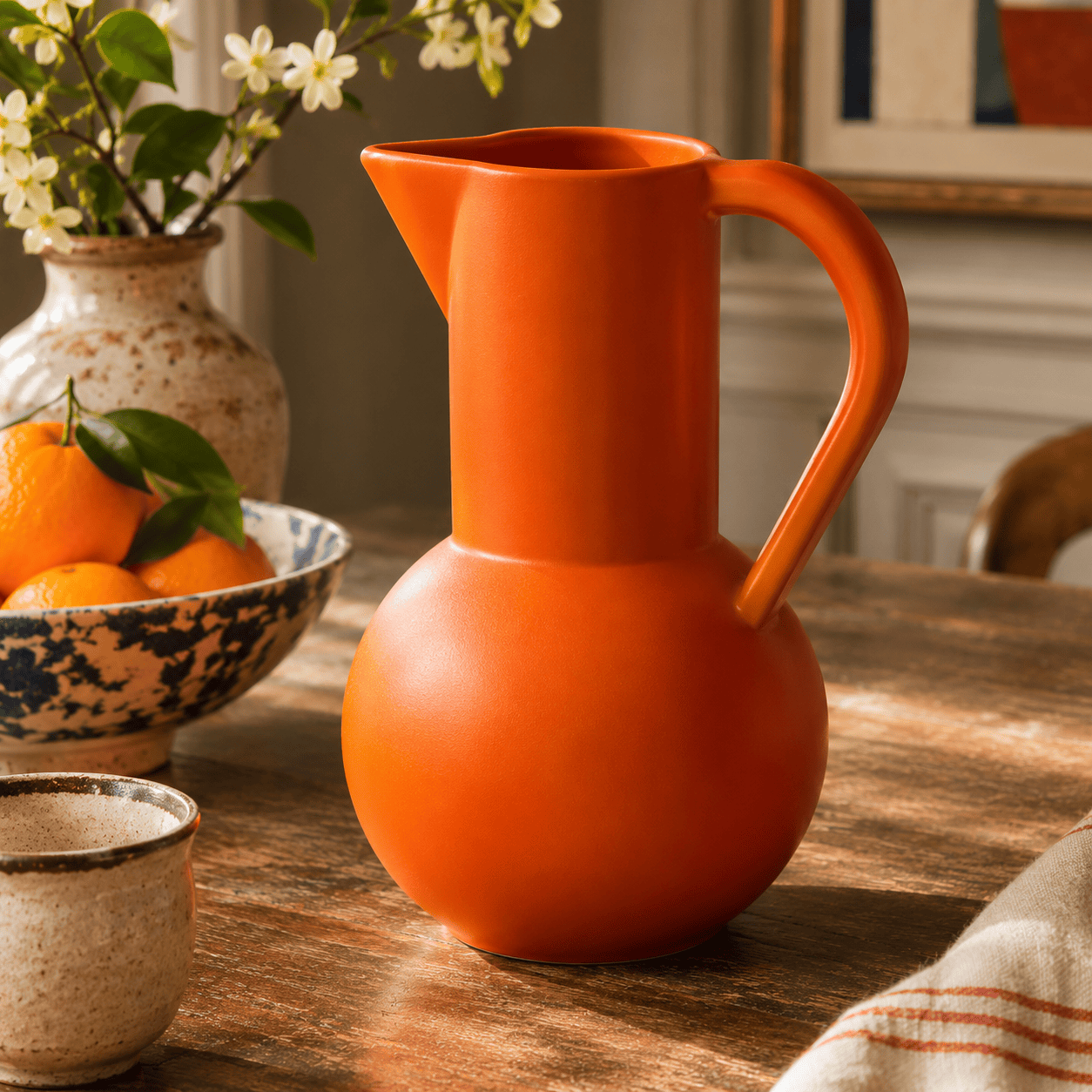
The jug is perhaps the most expressive member of that family. Its spherical body, cylindrical neck and sharply defined pouring spout give it an almost architectural quality.
Seen in profile, it has the graphic simplicity of a painted shape. Viewed from another angle, its proportions and curves reveal a rather different personality.
The designer’s achievement lies in retaining the spirit of Lundstrøm’s paintings without producing something that feels like a museum souvenir.
Handmade in Portugal, the ceramic pieces bring the precision of geometric design together with the individuality of traditional production techniques.
Colour changes the way we perceive the object itself.
A rather different kind of Scandinavian design.
We have become accustomed to a particular interpretation of Scandinavian interiors: pale timber, quiet neutrals and an almost religious devotion to restraint.
Yet Nordic modernism has a much richer relationship with colour than this familiar aesthetic might suggest.
Wiig-Hansen developed a palette of glazes specifically for the collection, allowing the ceramic forms to take on distinct personalities.
In vibrant orange, the jug introduces warmth and energy. In blue, the same silhouette feels cooler and more architectural. Softer colours bring attention to the subtleties of its form.
Placed on a traditional wooden table, the orange jug becomes particularly interesting. The patina of aged timber and the irregularities of older ceramics make its confident geometry feel even more pronounced.
Neither the old nor the new diminishes the other. Their differences are precisely what make the arrangement work.
The objects we grow attached to.
A household object can acquire significance through the simplest of repeated rituals. The jug brought out at family lunches, the bowl that always holds fruit, the vase filled with flowers from the garden.
Their value eventually has very little to do with their original purpose or monetary worth. They become part of the way we remember people, places and particular moments in our lives.
Perhaps this is what makes the Strøm particularly interesting. For all its artistic references and carefully considered proportions, it remains an object intended to be used.
There is no need to reserve it for special occasions or keep it permanently on display. Its character is just as evident when it is holding water on the dining table as when it stands alone on a shelf.
A little art in the everyday.
There is a tendency to think of art as something that hangs on a wall, separate from the ordinary business of living.
The Strøm Jug offers a gentle challenge to that distinction.
On a kitchen counter, it becomes part of an evolving still life. Alongside a few pieces of fruit, a folded linen cloth or a favourite bowl, it creates the kind of composition that Lundstrøm himself might have found interesting.
And tomorrow, it can simply hold the water for lunch.
Good design does not always demand a special occasion. Sometimes, its greatest contribution is to make the ordinary moments of our lives a little more beautiful.
Design notes.
- Object
- Strøm Jug
- Designer
- Nicholai Wiig-Hansen
- Design Brand
- raawii
- Originally Designed
- 2016
- Collection Introduced
- 2017
- Artistic Inspiration
- Vilhelm Lundstrøm
- Material
- Glazed earthenware
- Country of Production
- Portugal
Further reading: Strøm by Nicholai Wiig-Hansen, the story behind the collection. Interior imagery by Houszed, for design inspiration.

BEHIND THE STORY
Natalie Jones
Natalie Jones explores the creative side of interior design, with a particular interest in colour, texture and the details that give a room its personality. Her writing celebrates thoughtful decorating, individual style and the pleasure of creating a home that feels entirely your own.